


|
On May 23, 2007, the EEOC took an important step toward ending employment discrimination against family caregivers by issuing enforcement guidance that will educate employers and employees about caregivers’ rights and responsibilities.
The Guidance advises that discrimination can take the form of different treatment of men and women with young children, such as selecting fathers but not mothers for a training program. It also advises that discrimination can take the form of stereotyping, such as giving less desirable assignments to mothers on the assumption that they are not as committed to their jobs. Examples of common scenarios for discrimination are provided throughout. The Guidance can be viewed on the EEOC’s website.
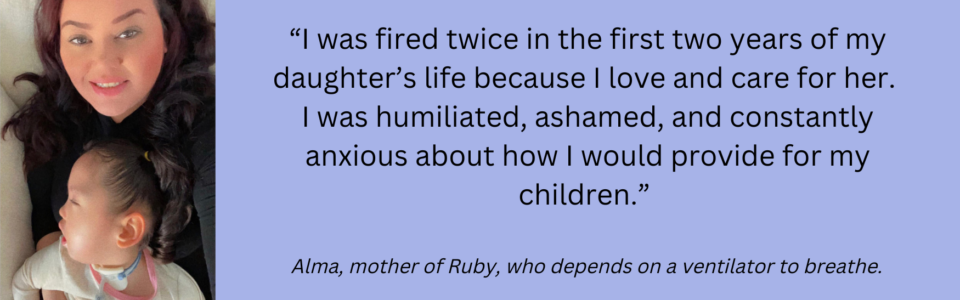
Family Responsibilities Discrimination (FRD) is employment discrimination against workers based on their family caregiving responsibilities. Pregnant women, mothers and fathers of young children, and employees with aging parents or sick spouses or partners may encounter FRD. They may be rejected for hire, passed over for promotion, demoted, harassed, or terminated -- despite good performance -- simply because their employers make personnel decisions based on stereotypical notions of how they will or should act given their family responsibilities.
FRD is also called “caregiver discrimination.” You can read the EEOC’s Enforcement Guidance on caregiver discrimination on the EEOC web site.
WorkLife Law’s FRD Fact Sheet provides an overview of the types of situations that commonly lead to FRD claims.
While most FRD plaintiffs are women, men are increasingly facing FRD in the workplace as they care for their families. You can read about men and FRD here.
FRD affects men and women across the income spectrum and employers in every industry. Cases have included those in low-wage jobs (grocery clerks, nurses' aides), pink-collar jobs (administrative assistants, teachers), blue-collar jobs (police, firefighters), and professional/managerial jobs (lawyers, doctors, executives). Here are some examples of FRD:
- firing
or demoting employees when they become
pregnant;
- passing
over highly qualified mothers for hire or promotion in
favor of less qualified fathers or women without
children;
- firing
employees without valid business reasons when they
return from maternity or paternity leave;
- denying
flexibility to employees who want it for child care
reasons, while allowing flexibility to employees for
non-family reasons (e.g., to participate on a sports
team);
- firing
employees whose spouses or elderly parents become
disabled for fear of increased absenteeism or higher
health insurance premiums; and
- fabricating
work infractions or performance deficiencies to
justify dismissal of employees with family
responsibilities.
Have questions about FRD? Check out WorkLife Law’s Frequently Asked Questions. If you need more information, send your questions to info@worklifelaw.org.
|